Affordable Root Canal Treatment in Rajajinagar

Skip to content

If your jaw clicks every time you open your mouth wide, or you’ve started waking up with a dull ache near your ears, you’ve probably already typed some version of “why does my jaw hurt” into your phone at 1 a.m. You’re not imagining it, and you’re not overreacting. Jaw pain that lingers for more than a couple of weeks may be linked to temporomandibular joint disorder, or TMJ disorder, one of the more commonly overlooked dental complaints we see at our hospital in Rajajinagar. Getting the right jaw pain treatment starts with identifying what is causing discomfort, whether it’s teeth grinding, jaw clenching, bite problems, muscle tension, or an issue affecting the TMJ itself.
The tricky part about TMJ pain is that it rarely shows up looking like a “dental problem.” People come to us thinking they have an ear infection, a sinus issue, or plain old stress headaches, and it’s only during the examination that the jaw joint turns out to be the real source.

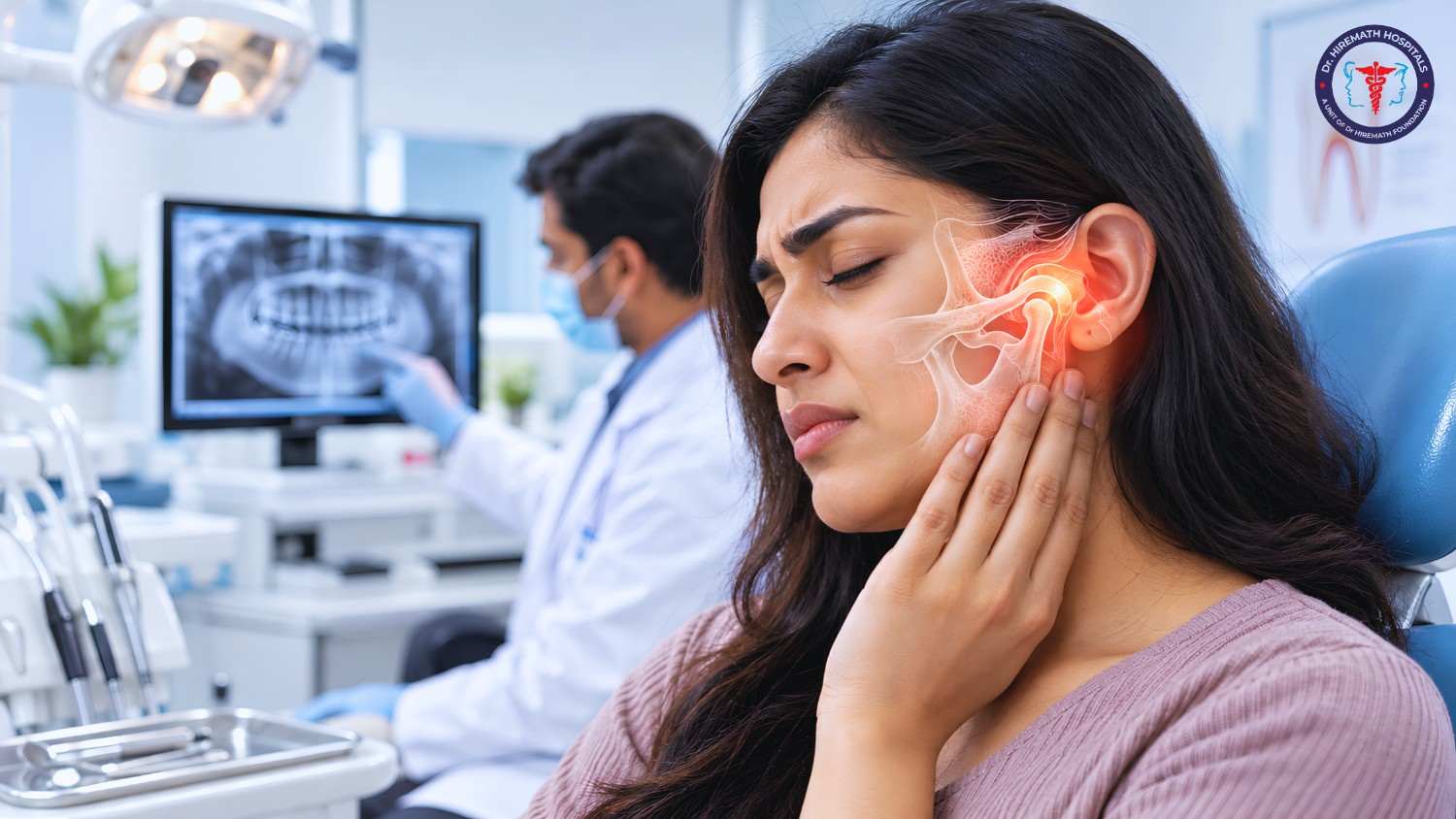
The temporomandibular joint sits just in front of your ears, on both sides of your face, connecting your lower jaw to your skull. It’s one of the most-used joints in your body, every time you talk, chew, yawn, or even swallow, it’s working. Because it’s a sliding hinge rather than a simple pivot, it’s also more prone to wear, misalignment, and inflammation than most people realize.
TMJ disorder isn’t one single condition. It’s an umbrella term for a group of problems affecting the joint, the surrounding muscles, or both. In our practice, the most common triggers we see include:
Most patients wait far too long before getting this checked, partly because the symptoms are easy to explain away. Here’s what tends to separate ordinary jaw fatigue from an actual TMJ disorder that needs attention:
If two or more of this sound familiar and they’ve been going on for weeks rather than days, it’s worth getting the joint properly examined rather than continuing to manage it with painkillers.
A jaw joint problem can’t be diagnosed by simply looking at the outside of the face, it needs a proper clinical and imaging-based assessment. At our hospital, this typically includes:
This step matters more than people expect. A lot of “TMJ treatments” sold online generic exercises, random mouthguards, assume every jaw pain case is identical. A bite problem needs a completely different approach than, say, arthritis in the joint or a grinding habit.
The good news is that the vast majority of TMJ cases respond well to non-surgical treatment, especially when caught early. Depending on what’s driving your symptoms, treatment may include:
What we’ve learned after years of treating jaw pain cases from across Rajajinagar and the surrounding neighbourhoods is that most people don’t need surgery, they need an accurate diagnosis and a plan that matches the actual cause, not a one-size-fits-all mouthguard.
For mild, occasional discomfort, a few simple steps can help while you wait for your appointment:
That said, home care is a bridge, not a treatment. If pain persists for two to three weeks, or if your jaw is locking, clicking loudly, or affecting how you eat and speak, it’s time for a proper evaluation.
One of the reasons jaw pains often goes untreated is cost anxiety, people assume specialized treatment for something like TMJ disorder will involve an expensive series of consultations, scans, and appliances. At Dr Hiremath Charitable Dental Hospital in Rajajinagar, our model is built around removing exactly that barrier: patients pay only for the materials used in their treatment, with no separate consultation or service charges layered on top. Whether your case needs a simple bite splint or advanced imaging to rule out joint damage, the goal is the same an accurate diagnosis and honest treatment plan, without the pricing games.
If jaw pain, clicking, or morning headaches have been part of your routine for weeks now, it’s worth getting it looked at properly rather than continuing to work around it. Our team is based in Rajajinagar and sees jaw and bite-related cases regularly, using OPG and CBCT imaging on-site to get a clear, complete picture before recommending any treatment.
Dealing with jaw pain that won’t go away? Walk in for an evaluation at Dr Hiremath Charitable Dental Hospital, Rajajinagar, or call +91 96060 60189 to book a check-up.
TMJ jaw pain is mostly caused by teeth grinding or clenching (bruxism), an uneven bite, jaw injury, or joint-related conditions like arthritis. Stress often makes these underlying causes worse by increasing muscle tension around the jaw.
Mild, short-term jaw discomfort caused by occasional overuse can settle with rest and home care. However, ongoing symptoms of clicking, locking, or pain lasting more than two to three weeks usually need a proper dental evaluation, since the underlying cause (like a bite problem or grinding habit) won’t resolve by itself.
Not always, Jaw clicking when opening mouth can occasionally occur without causing any pain or other problems. However, if the clicking is accompanied by jaw pain, difficulty opening your mouth, or the jaw catching or locking, it may indicate an issue with the TMJ joint or disc that needs proper evaluation.
For most patients, custom-fitted night guard, bite correction, and targeted jaw exercises provide significant relief. Laser therapy is also used to ease muscle-related jaw pain. Surgery is only considered when conservative treatments don’t resolve structural joint damage.
Costs vary widely depending on whether treatment involves a simple splint, bite correction, or advanced imaging like a CBCT scan. At Dr Hiremath Charitable Dental Hospital in Rajajinagar, patients pay only for the materials used in their treatment, with no additional consultation or service fees.