Affordable Clear Aligners Bangalore

Skip to content
If chewing your food has started to feel like a chore, if your jaw clicks every time you yawn, or if a mirror check keeps reminding you that your chin sits further back (or forward) than it should, you may have already typed “jaw surgery in Rajajinagar” into Google at 1 a.m., half out of curiosity and half out of worry. That’s a completely normal way to land here.
Jaw surgery has a reputation for sounding drastic. It’s one of the most transformative, and most misunderstood branches of dental and maxillofacial care. It can fix a bite that’s never worked properly, correct a face that grew asymmetrically, repair a fracture after an accident, or quiet a jaw joint that’s been aching for years. At Dr Hiremath Charitable Dental Hospital in Rajajinagar, Bengaluru, this kind of surgery is planned by experienced oral and maxillofacial specialists and delivered on a not-for-profit model, so the decision to go ahead can be based on your health, not your bank balance.
This guide breaks down what jaw surgery involves, who typically needs it, how the process unfolds from first consultation to final recovery, and what makes charitable, community-focused care different from a typical private hospital bill.

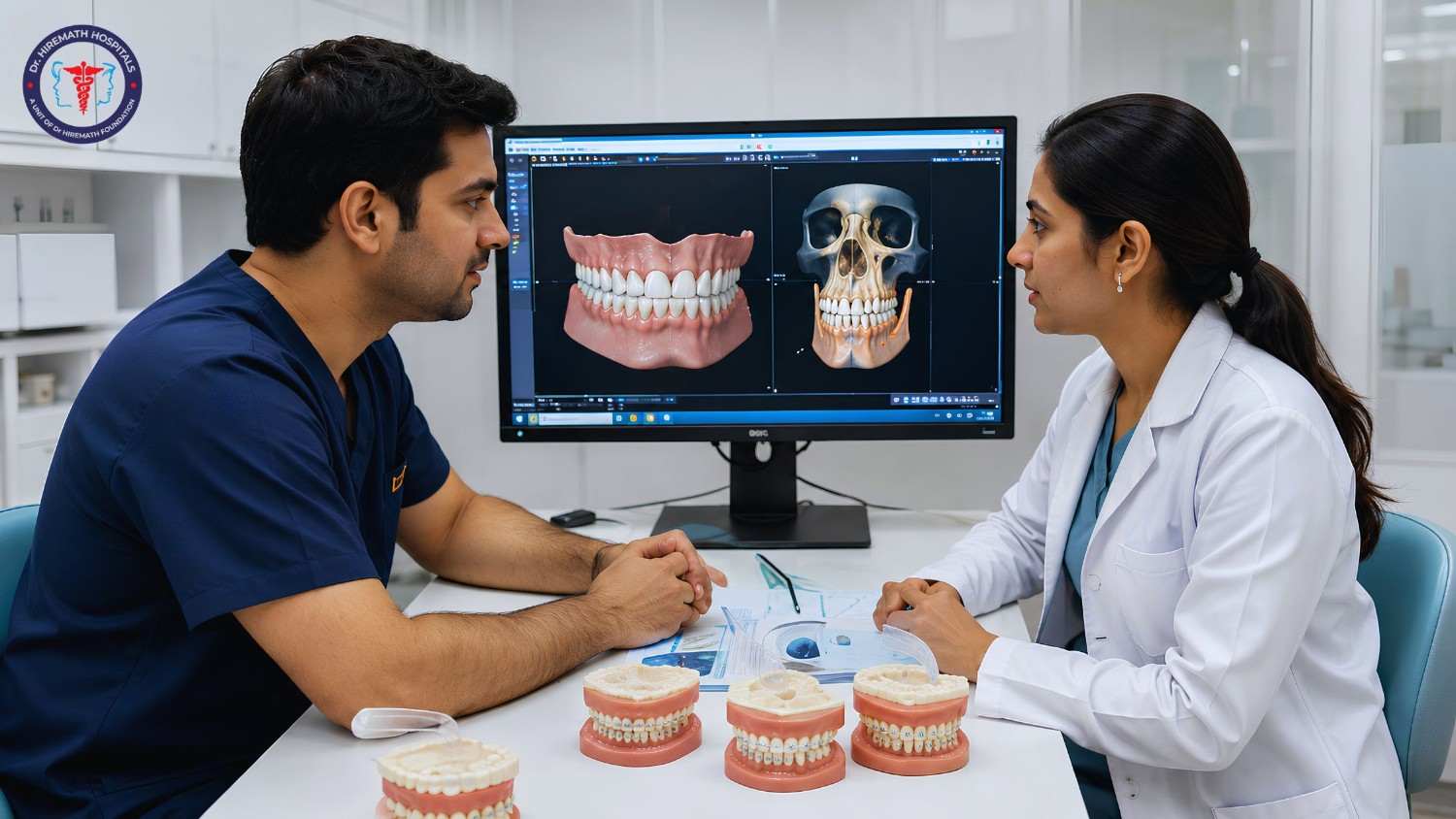
In dentistry, jaw surgery usually refers to orthognathic surgery, a procedure that repositions the upper jaw (maxilla), lower jaw (mandible), or both, to correct how they fit together. But the term also covers related procedures: surgery for jaw joint (TMJ) disorders, reconstruction after trauma or fracture, removal of cysts or tumours that have weakened the jawbone, and chin-reshaping surgery known as genioplasty.
Unlike a filling or a crown, jaw surgery changes the underlying skeletal framework of the face. That’s why it’s never a same-day decision, it involves imaging, a physical examination, often a period of orthodontic preparation, and a surgical team that plans every millimetre of movement before you’re anywhere near the operating table.
This is the most common category and addresses skeletal bite problems cases where braces or aligners alone can’t fix the misalignment because the bones themselves, not just the teeth, are out of position.
For patients with chronic jaw joint pain, locking, or clicking that hasn’t responded to splints, physiotherapy, or medication, surgical options range from minimally invasive arthroscopy to open joint surgery in more advanced cases. This is usually the last step after conservative treatment has been tried.
Road accidents, sports injuries, and falls are common causes of jaw fractures in a city like Bengaluru. Surgery here focuses on realigning and stabilising the bone often with titanium plates and screws, so the jaw heals in its correct position and normal chewing function returns.
Sometimes the bite is fine, but the chin is too small, too large, or off-centre. Genioplasty repositions the chin bone independently and is often combined with orthognathic surgery for a balanced facial profile.
When a benign growth has weakened a section of the jawbone, reconstructive surgery sometimes with bone grafting restores strength and shape after the growth is removed.
Not every bite problem needs surgery, and a qualified oral surgeon will always explore non-surgical options first. That said, these signs are worth getting evaluated:
If two or more of this sound familiar, a consultation with imaging is the right next step not a decision to book surgery, just a decision to find out where you stand.
Recovery is gradual, and patience matters more than speed here.
Every patient heals at a different pace, and your surgical team will guide diet, activity, and follow-up visits specific to your case.
As with any surgery involving general anaesthesia and bone repositioning, jaw surgery carries risks temporary numbness, swelling, minor bite adjustments needed afterward, and, rarely, infection or bleeding. These risks are why thorough imaging, an experienced surgical team, and a well-planned pre- and post-operative protocol matter so much. A hospital that invests in proper diagnostics CBCT scans, careful case planning, and a qualified maxillofacial team significantly reduces these risks compared to a rushed or under-equipped setup.
Jaw surgery in India, and particularly in a metro like Bengaluru, can run into several lakhs of rupees at private corporate hospitals once you add surgeon fees, hospital stay, implants, imaging, and post-operative orthodontics. For a lot of families, that number alone is reason enough to keep postponing a surgery they genuinely need sometimes for years.
Dr Hiremath Charitable Dental Hospital was built to interrupt exactly that pattern. As a not-for-profit hospital, patients pay only for the materials and equipment used in their treatment, with no consultation charges and no service mark-up layered on top. Advanced diagnostic tools like OPG and CBCT imaging are available on-site, so treatment planning doesn’t require running between multiple centres, and every case is assessed on clinical need rather than what generates more billing.
For Rajajinagar residents, this means a genuine second opinion, a proper imaging-based diagnosis, and an honest conversation about whether you need surgery at all, is available close to home, without the financial second-guessing that often delays care until symptoms worsen.
Jaw surgery sounds bigger than most other dental procedures because, structurally, it is,but that doesn’t mean it should stay out of reach. With the right diagnosis, a properly sequenced treatment plan, and a surgical team that explains every stage clearly, it becomes a manageable, life-improving process rather than an intimidating one.
If you’re in Rajajinagar or elsewhere in Bengaluru and dealing with a bite that’s never felt right, jaw pain that won’t ease up, or the after-effects of an old injury, Dr Hiremath Charitable Dental Hospital offers an ethical, transparent starting point, a proper evaluation, without the pressure of an inflated bill.
📍 Visit us: 4th N Block, 48/2, 59th B Cross Rd, Rajajinagar, Bengaluru, Karnataka, 560010 📞 Call: +91 9606060189 🕒 Hours: Mon–Sat, 9:30 AM–8:30 PM | Sun, 9:30 AM–2:30 PM
Pain is well-controlled with prescribed medication and is generally most noticeable in the first three to four days, driven mainly by swelling rather than the surgical site itself. Most patients describe it as manageable discomfort rather than severe pain, and it steadily eases over the following weeks.
Initial recovery is enough to return to normal routines, and softer solid foods usually take six to eight weeks. Complete bone healing and final facial settling can take anywhere from three months to a full year, depending on the complexity of the case.
No. Orthodontic treatment (braces or aligners) moves teeth within the jawbone, while jaw surgery repositions the jawbone itself. Many patients need both orthodontics before and after surgery because braces alone cannot correct a skeletal misalignment.
In most orthognathic procedures, incisions are made inside the mouth, so there is little to no visible external scarring. Trauma-related reconstructive surgery may occasionally require a small external incision, depending on the fracture’s location.
At Dr Hiremath Charitable Dental Hospital, patients pay only for the materials and equipment used during treatment, with no added consultation or service charges. This charity-based model makes surgical evaluation and treatment considerably more affordable than typical private hospital pricing in Bangalore.