Affordable Wisdom Tooth Removal in Bangalore

Skip to content

A missing milk tooth might look like a small thing. Maybe it fell out from decay, maybe from a fall on the playground. Either way, most parents breathe a sigh of relief once the discomfort is gone, and life moves on.
Here’s what many parents in Rajajinagar don’t realise: an early gap in a kids mouth doesn’t stay empty for long. Neighbouring teeth begin to drift, tilt, and lean into that open space within weeks. By the time the permanent tooth is ready to come through months later, there may simply be no room left for it.
This is exactly the problem a space maintainer is built to solve. It’s one of the most underrated appliances in children’s dentistry, and at Dr Hiremath Charitable Dental Hospital in Rajajinagar, it’s a treatment we recommend often, at a cost that never puts a family under pressure.

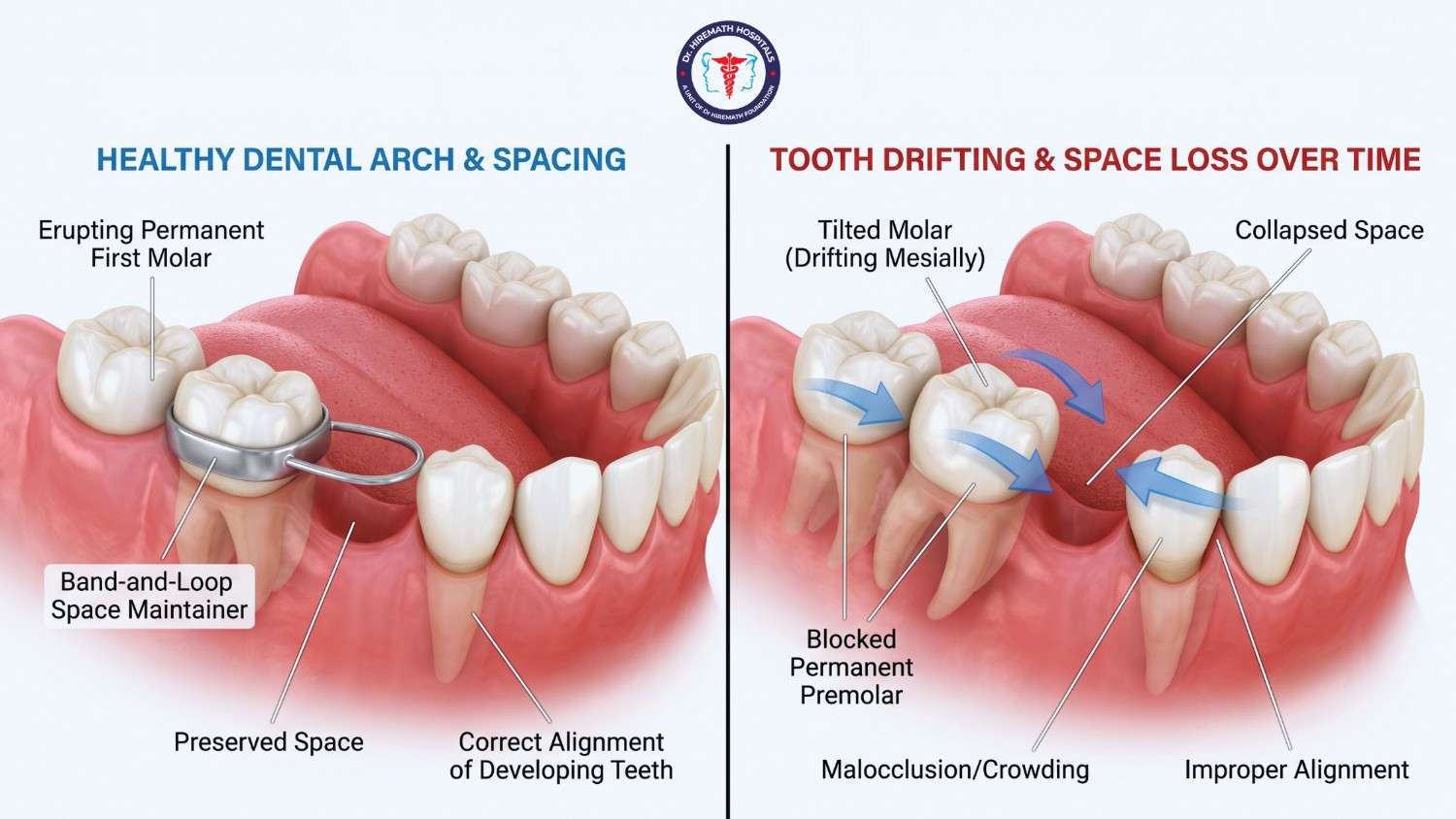
A space maintainer is a small custom-made dental appliance, usually made of metal or a tooth-coloured composite, that is fitted into the gap left by a prematurely lost baby tooth. Its only job is to hold that space open until the permanent tooth underneath is ready to erupt naturally into its correct position.
Think of it as a placeholder. It doesn’t do any active tooth-moving work like braces do; it simply prevents the surrounding teeth from shifting sideways or backward and closing up the gap before the new tooth arrives.
Baby teeth aren’t just for chewing and smiling. They act as natural guides for the permanent teeth growing beneath the gums. When a baby tooth is lost years before it’s meant to fall out on its own, that natural guidance disappears, and the developing bite can go off course.
A few common reasons bring young patients to our pediatric dental chair for this exact concern:
Whatever the cause, once a milk tooth is gone ahead of schedule, the clock starts ticking on space maintenance.
Parents often ask us this directly, and it’s a fair question. If a permanent tooth is coming anyway, why not just wait?
Without a space maintainer, several things tend to happen over the following months:
In short, a low-cost, painless appliance today can prevent a much bigger, costlier correction later.
Every kids mouth is different, so the appliance is chosen based on which tooth was lost and how much space needs protecting.
Our pediatric dental team examines the child’s dental X-ray, the eruption timeline of the succeeding tooth, and the child’s comfort level before recommending the right type.
Parents in Rajajinagar are often surprised at how simple this visit turns out to be. There’s no drilling into healthy tooth structure and no pain involved.
Most children adjust to the appliance within a day or two and go back to eating, talking, and playing normally.
A little home care goes a long way in keeping the appliance effective and the surrounding teeth healthy:
We understand that many parents delay a kids dental visit simply because of cost concerns, and that hesitation is exactly what our charitable model was built to remove.
At Dr Hiremath Charitable Dental Hospital in Rajajinagar, Bengaluru, families pay only for the materials used, not for consultation or service charges. That means a child who needs a space maintainer receives it based on clinical need, never based on what a family can afford to spend.
Our pediatric dentistry setup is built around gentle, child-friendly handling, so first-time visits don’t turn into a battle. Combined with modern diagnostic tools like OPG and CBCT imaging, our dentists can accurately time when a space maintainer is needed and when it should come out, so treatment is neither delayed nor left in place longer than necessary.
If your child has lost a baby tooth earlier than expected, whether from decay, trauma, or infection, it’s worth getting a dental check-up within a few weeks rather than waiting for the next scheduled visit. Early evaluation gives the dentist the best chance to fit a space maintainer before the neighbouring teeth start shifting.
4th N Block, 48/2, 59th B Cross Rd, Rajajinagar, Bengaluru, Karnataka, 560010
📞 Call: +91 96060 60189
🕒 Mon–Sat: 9:30 AM – 8:30 PM | Sun: 9:30 AM – 2:30 PM
A short conversation with our team today can save your child years of more complicated orthodontic correction down the road.
Space maintainers are most commonly needed between ages 4 and 11, whenever a baby tooth is lost significantly earlier than its natural exfoliation time, leaving the permanent tooth beneath not yet ready to erupt.
No. Fitting a space maintainer is a painless, non-invasive procedure. There’s no drilling into the tooth structure, and most children feel only mild pressure during the fitting, similar to trying on a retainer.
It varies by case, but most space maintainers stay in place for 6 months to 2 years, until the permanent tooth has erupted enough that the appliance is no longer needed and can be safely removed.
Yes, if it isn’t checked regularly or if a child chews on sticky or hard foods, the cement bond can weaken and the appliance may come loose. Regular dental review appointments help catch this early.
No. A space maintainer is passive; it only holds existing space open. Braces actively move teeth into new positions. A space maintainer can, however, reduce or eliminate the need for extensive braces treatment later.