Impacted Wisdom Tooth Removal in Rajajinagar

Skip to content

You’ve probably heard the words “root canal” and immediately felt your stomach drop. It’s one of those phrases in dentistry that carries decades of unfair baggage, scary stories passed around by people who got the procedure done thirty years ago when techniques were genuinely uncomfortable. Here’s the truth: modern root canal treatment is nothing like that old reputation suggests, and millions of teeth are saved every year because of it.
If you are in Rajajinagar or anywhere in northwest Bangalore and you’re dealing with a persistent toothache, sensitivity to hot and cold that lingers, or a tooth that just feels “off”, this guide is written for you. We’ll walk through everything plainly: what root canal treatment actually involves, when you need it, what it feels like today, and why getting it done at a charitable dental hospital doesn’t mean you’re settling for less – especially when you choose root canal treatment in Rajajinagar at a trusted dental hospital near Rajajinagar.

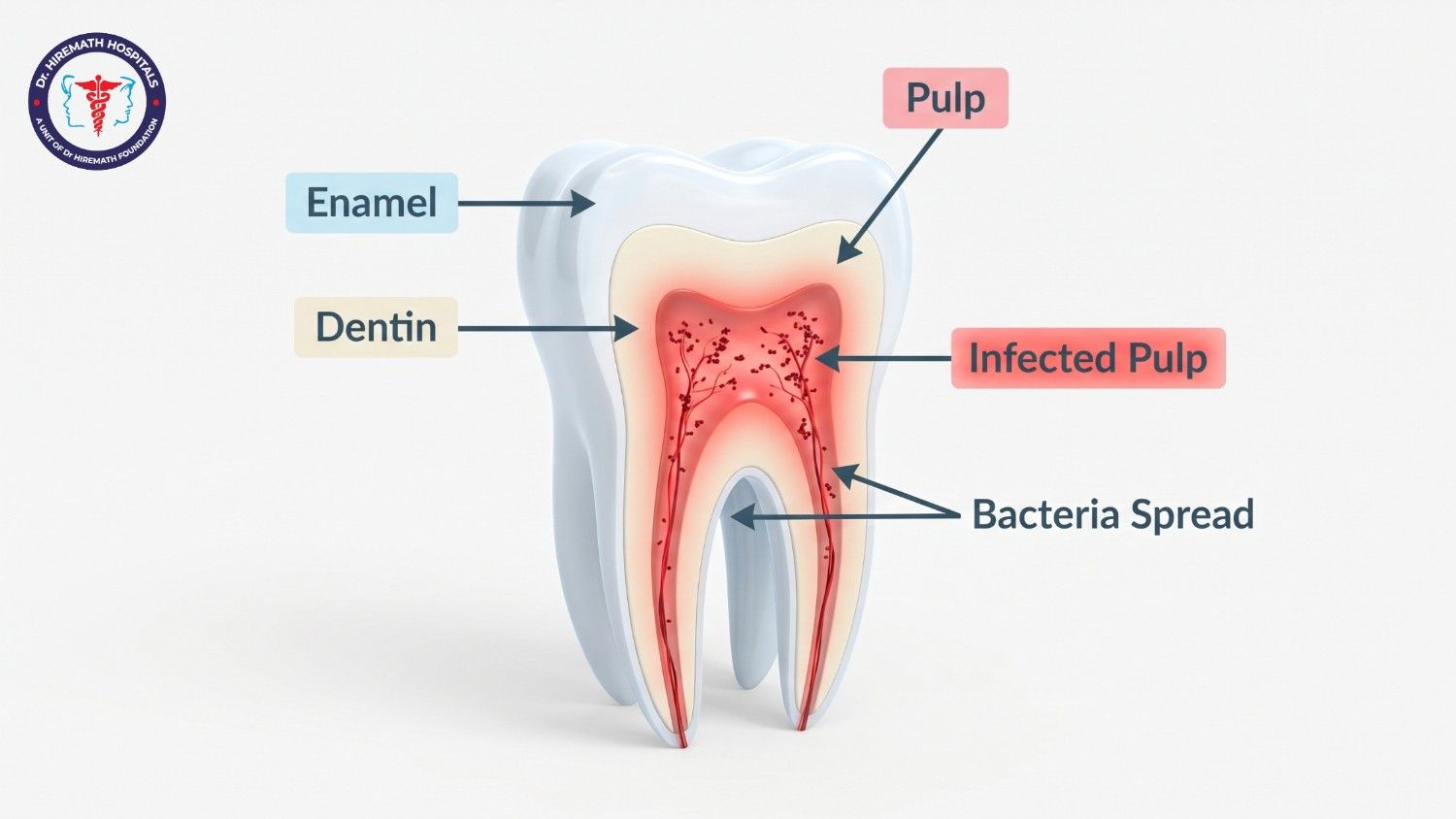
Inside every tooth, beneath the hard enamel and the ivory-like dentin layer, there’s a soft core called the dental pulp. This pulp contains nerves, blood vessels, and connective tissue, it’s what kept your tooth alive as it developed. Once the tooth is fully formed, the pulp is no longer essential to survival. The tooth can function perfectly well without it, nourished instead by the surrounding tissues.
Root canal treatment (RCT) is the process of removing infected or inflamed pulp from inside the tooth, cleaning and shaping the root canals, and sealing the tooth so bacteria cannot re-enter. The tooth stays in place. You keep your natural smile. The pain that brought you to the dentist in the first place, gone.
Think of it less like surgery and more like a thorough internal cleaning.
The most common reasons pulp becomes infected or inflamed include:
Deep tooth decay, When a cavity is left untreated for too long, the bacteria eventually reach the inner pulp. At that point, a simple filling is no longer enough. The infection must be addressed from the inside.
A cracked or fractured tooth, A crack, even a small hairline fracture from biting something hard, can expose the pulp to oral bacteria over time.
Repeated dental procedures on the same tooth, A tooth that has been filled, refilled, and treated multiple times may develop pulp sensitivity or inflammation even without an obvious new cause.
Trauma, A knock or blow to the mouth, from sports, an accident, or a fall, can damage the pulp internally even when the tooth looks intact on the outside.
Gum disease, Advanced gum disease that has reached the roots can allow bacteria to enter through the root tips.
In all these cases, the result is the same: the pulp is compromised, bacteria multiply inside the tooth, and without intervention, the infection spreads outward into the bone.
Not every toothache means you need a root canal, but certain symptoms are a clear signal that something is happening inside the tooth that needs proper evaluation:
If you’re experiencing any combination of these symptoms, don’t wait. A quick consultation can determine whether you need root canal treatment or whether a simpler solution will work.
Here’s exactly what happens during a root canal appointment so there are no surprises.
The dentist examines your tooth, takes a digital X-ray (or a CBCT scan for complex cases), and assesses the extent of infection. This determines whether a root canal is the right treatment and how many canals the tooth has, front teeth have one or two, molars can have three or four.
A local anaesthetic is injected into the area around the tooth. Within a few minutes, the tooth and surrounding gum are completely numb. This ensures a root canal without pain Bangalore experiences.
A thin rubber sheet (rubber dam) is placed around the tooth to isolate it from the rest of the mouth. This keeps the area clean, dry, and free from saliva during treatment.
The dentist makes a small opening through the crown (top) of the tooth to access the inner pulp chamber. You won’t feel this, the anaesthesia ensures complete numbness.
Using very fine, flexible instruments called endodontic files, the dentist removes the infected pulp from each root canal. The canals are then shaped and flushed with an antibacterial solution to eliminate any remaining bacteria. This step is methodical and thorough, it’s the heart of the procedure.
For cases with significant infection, the dentist may place an antibacterial medication inside the tooth and place a temporary filling. You return after one or two weeks once the infection has settled.
The cleaned canals are filled with a rubber-like biocompatible material called gutta-percha, which seals the space completely. A permanent filling or crown is then placed on top to restore the tooth’s structure and protect it.
After treatment, the tooth looks and functions exactly like any other tooth in your mouth.
This is the question almost every patient asks first, and it deserves a direct answer.
During the procedure, No. With modern local anaesthesia, you should not feel pain. You’ll feel some pressure, vibration, or occasional mild discomfort if the anaesthetic wears thin, but your dentist will adjust accordingly.
After the procedure, Mild soreness for 48,72 hours is normal. The tissues around the tooth have been through a procedure and they react accordingly. Over-the-counter pain medication (like ibuprofen or paracetamol) manages this comfortably for most people.
Compared to doing nothing, The pain from an untreated infected tooth is significantly worse, more persistent, and will escalate. Most patients say the root canal was far less painful than the toothache that brought them in.
The fear is understandable. It’s also largely inherited from a pre-modern era of dentistry. Today, a well-performed root canal is genuinely a comfortable procedure.
This is a fair concern, and it deserves an equally fair answer.
At Dr. Hiremath Charitable Dental Hospital in Rajajinagar, the charitable model doesn’t mean reduced standards of care. It means a fundamentally different financial structure. Patients pay only for the materials used, gutta-percha, dental cements, temporary filling materials, and not for service time or consultation. No service charges are added.
What the hospital does not compromise on:
The charitable model was built on a simple conviction: quality dental care should not be a luxury available only to those who can afford premium clinic prices. A root canal treatment here is the same procedure, performed with the same materials and the same standard of care, as anywhere else. The difference is in what you pay, not what you receive.
Many people wonder, is it easier to just take the tooth out? It’s a logical question. But here’s what extraction costs you in the long run:
When a tooth is removed, the jawbone beneath it begins to gradually resorb (shrink) because there is no root to stimulate it. Neighbouring teeth tilt slowly into the gap over months and years. The tooth above the gap super-erupts downward trying to find contact. Bite alignment shifts. Chewing efficiency reduces.
To replace a missing tooth properly, you’d likely need a dental implant, a bridge, or a partial denture, all of which cost significantly more than a root canal and crown, and none of which are quite like your original tooth.
Root canal treatment lets you keep the tooth. The tooth keeps the bone. The bone keeps the structure of your face and jaw intact. From a long-term dental health perspective, preservation will almost always come out ahead.
Recovery is generally straightforward with a few sensible habits:
In the first 48 hours: Avoid chewing hard or crunchy food on the treated side. Stick to softer foods like rice, yogurt, dal, and cooked vegetables. Take any prescribed antibiotics and pain relief as directed.
Oral hygiene: Continue brushing gently and flossing normally. The temporary filling is robust enough for regular brushing.
The crown: If your tooth hasn’t received a permanent crown yet, avoid biting hard on that side. A root-canal-treated tooth is more brittle without its crown, protecting it is important.
Follow-up: Attend your scheduled review appointment. The dentist will confirm healing is progressing correctly and complete the final restoration.
Longer term: A well-treated root canal tooth with a good crown can last a lifetime with proper oral hygiene and regular dental check-ups.
Located in the 4th N Block area of Rajajinagar, the hospital is easily accessible to residents across northwest Bangalore, from Rajajinagar itself to Magadi Road, Vijayanagar, Basaveshwaranagar, and beyond.
The hospital has received recognition as Best Free Charitable Dental Hospital in Bengaluru and the KTCC Karnataka Business Awards 2024, acknowledgements of quality, not just affordability.
For families who have been putting off dental treatment because of cost, or for patients who are frustrated with clinics that recommend treatments based on billing rather than clinical need, this is a different kind of place.
Appointments can be booked directly via WhatsApp at +91 9606060189.
Clinic hours: Monday to Saturday, 9:30 AM, 8:30 PM | Sunday, 9:30 AM, 2:30 PM
Modern root canal treatment performed under local anaesthesia is largely painless. Most patients report that the procedure itself is far more comfortable than the toothache they were experiencing before it. Any mild soreness after the treatment usually settles within 48-72 hours.
Root canal treatment costs in Bangalore can range from ₹2,000 to ₹15,000 per tooth at private clinics, depending on the tooth type and complexity. At Dr. Hiremath Charitable Dental Hospital in Rajajinagar, patients pay only for materials – no service fee is charged – making it one of the most affordable options in the city.
Most root canal treatments are completed in 2-3 sittings. Single-sitting root canals are possible for straightforward cases. Multi-visit procedures are recommended when there is severe infection or complex root anatomy requiring careful cleaning and medication.
Dentists universally recommend saving your natural tooth through root canal treatment whenever possible. Your natural tooth maintains jawbone integrity, preserves bite function, and prevents neighbouring teeth from shifting. Tooth removal should only be the last option when the tooth is beyond salvage.
Delaying a root canal allows the infection to spread from the tooth pulp to surrounding bone and tissues. This can lead to a dental abscess, swelling, bone loss, and in severe cases, systemic infection. The longer you wait, the more complex – and costly – the treatment becomes.